Friday, September 30, 2011

SCBWI 2011 Agents Party


In the words of the inimitable Sun: Phew! What a Scorcher!

(with apologies to Scarlett, but her pose summed it up!)
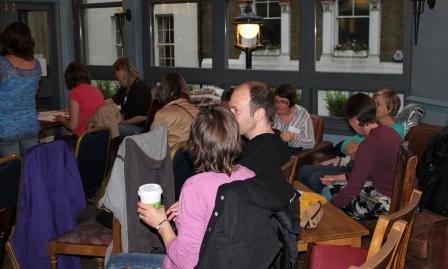
On the hottest September day for over a century, a packed roomful of SCBWI folk met to meet, schmooze and generally pick the brains of a panel of six assorted agents. And it turned out that it wasn't just the room that was going to be hot that evening, but more of that anon.

Benjamin Scott, Assistant Regional Adviser, kicked off proceedings with brief introductions and then asked each of the agents to provide a little bit of backgroud to their agency, themselves, and reveal the all important information about their current wish list.

Zoe King from the Blair Partnership:

That's Zoe, in black and smiling
Zoe was Associate Agent and Head of Non Fiction at Darley Anderson Agency for over 6 years and helped to grow their children's and YA representation. She is now Senior Associate Agent at the Blair Partnership. The agency has only been running for 3 months. and kicked off with JK Rowling as their client! They are very much open to submissions; indeed Zoe only has 3 clients at the moment. Their intention is to provide a lot of editorial help to new authors, along with brand development and they are hoping to take on a few new clients each year and grow them into commercial writers.

Zoe's wish list comprises:
  • new frontiers/space/utopias (following on from distopian fiction)
  • historical to romance for the younger market
  • futuristic (scifi-light)
  • trolls and creatures
The submissions guidelines are on their website: first 10 pages plus a marketing type paragraph or jacket blurb.

Julian Friedman of Blake Friedman:
That's Julian with the potted plant hovering over his head 
Julian set up a literary agency in 1976 which then merged with Carole Blake to establish Blake Friedmann. He is well know for representing script-writers (indeed that's how he got into children's books: some of his scriptwriters started to them!) and has lectured all over the world on the business of scriptwriting. He is now diversifying into Young Adult fiction (definitely not younger children) and describes himself as the new kid on the block for all his experience in the industry in general. He still represents a lot of TV and film scriptwriters but finds the publishing inductry more satisfying because publishers don't 'option' a book and then fail to publish it unlike the film industry.

Julian's wish list is:
  • something with strong TV of film potential
  • aimed at 9 + and the older the better
  • transmedia/multi-platform potential - he wants whole story worlds that operate across a series of media
He prefers email submissions as they get about six to seven thousand a year. He is very unlikely to take on a completely unpublished writer unless there is something very, very special and well-developed about their project.

Alice Williams from David Highams Associates:

Alice has been representing Fiction, Non Fiction, and Children's for David Highams since 2002. She is currently concentrating largely on building her list of children's and young adult writers and has a burgeoning interest in graphic novels. The agency has 6 book agents of which 3 handle children's fiction. They also use interns and this means that Alice should be able to take on 2 or 3 more clients this year. She represents picture book, younger children and teen fiction writers and is also open to submissions form writer/illustrators.

Alice's wish list is:
  • humour for middle-grade boys
  • literary writing
and she is positvely NOT looking for scifi or anything which involves retelling a story.

She prefers email submissions (from both writers and illustrators).

Vicki Willden-Lebrecht of The Bright Agency:

Vicki is the founder, and MD of the Bright Group. They started off as an illustration agency dedicated to representing artists but are now expanding both geographically (into the US, and Asia) and functionally (into children's writers across the age range). They are very proactive about working in the electronic enviroment and also in taking on unpublished authors and illustrators. They like to concentrate on strategic management for their clients, for example matching different publishers for different types of work from the same client.  Vicki, herself concentrates on growing the agency and leaves the literary representation to Lauren Holowaty who heads up the literary division of the group. Before joining Bright, Lauren was a senior editor at Penguin.

Vicki's wishlist is:
  • good stories/characters
  • space
She is particularly interested in new writers too.

Bright Agency prefers email submissions from both writers and illustrators

Gillie Russell of Aitken Alexander:

Gillie started her publishing career at Methuen Children's Books where she worked with Anne Fine amongst others. For 10 years she was Publishing Director for Children's Fiction at Harper Collins, before joining Aitken Alexander in 2010. She is interested in great story telling and writing in any genre and for any age group.

Her wish list is:
  • a great voice
  • a good story
  • humour, especially for boys
  • new authors (she represents 6 clients currently)
  • cross over appeal (she notes that research undertaken by Littlebrown revealed that the average age of a YA reader was 26!)
  • a new Michael Morpurgo!
She prefers email submissions and they should include a short synopsis which is clear and exciting, a short bio and the first 3 chapters.

Claire Wilson from Rogers, Coleridge and White:

Claire joined RCW in 2007 and works alongside Pat White in the Children's Department.She currently looks after 9 clients across the full range of children's books and handles foreign rights for all children's titles at the agency.

Her wish list is:
  • a great voice - this is the most important thing of all
  • fantasy, scifi, humour, literary
 And she hates books that patronise the reader (don't underestimate their intelligence!)

She prefers email submissions and the instructions are on the website.


And then came the questions:

Describe a typical day:

Vicki explained that much of the day involves fielding stuff , trying to keep the inbox from managing you. It's all about mamanging people and relationships. Gillie calls this author care. She spends time trying to keep the pressure off authors. They all have to set aside specific time to read otherwise everything else gets in the way.

What happens to submissions?

Zoe explained that every agency is different. Darley Anderson don't use readers. So agents see all submissions. They imported this practice into the Blair Partnership. She always gives submissions a first look but sometimes she will ask other agents to look too. She finds it helpful to get a second opinion. 

Julian also takes a first look. He complains that most submissions are sent in too early and asks writers to make sure they've already had criticism on their work before submitting it. He commented that sometimes you find a great writer but the story isn't that good. In those circumstances he might help the writer find a good story.

Agents at the Bright Agency and RCW also read submissions. Claire explained that the chemistry between the author and agent is key, particularly with new authors where things can be very intense at the beginning.

Gillie agreed about getting another opinion but she uses interns to sift the submissions. She respects their opinion. And Alice explained that David Higham use a reader who is a published author herself. All submissions go to her first and she then passes it onto the appropriate agent.

What advice would you give people who have been waiting many months for a response from an agent?

Everyone agreed that if you haven't had a response after a couple of months it would be acceptable to chase but make sure you're polite and if possible chase the assistant rather than the agent!

How often do you take on work that you can't sell? 

They agreed that it does happen. Julian explained that it is important for writers to be able to promote themselves. This makes publishers more comfortable. So have a website, blog tweet. He thinks 20% of a published writer's life should be spent online and points to Darren Shan as a fine example of how to do it. Zoe warned not to underestimate the importance of an online presence but make sure it is manageable. She says if it isn't shiny, crisp and good then forget it!


And then we came to the draw! This is when, usually a small number of one to ones are offered by members of the panel to members of the audience. It's exciting for about two minutes and then for the overwhelming majority of people there's a degree of disappointment. But this year we had the most generous bunch of panellists ever and each time a name was drawn out, one of them would shout 'Ooo! I'll do another of those!' And so it went on. I'm not sure how many one to ones were won in the end, but everyone seemed to know someone who won.

Here's one of them:


And I was another! So what a scorcher indeed!

The formal bit of the meeting ended then and it was time for schmoozing. Sadly I had to leave to catch a train. Perhaps others will add comments to enlighten us all to what happened after 9pm. I for one wouuld love to know.

Many thanks to Liz de Jager for organising the event and to Zoe, Julian, Alice, Vicki, Gillie and Claire for their time and their generosity.


Wednesday, September 14, 2011

SCBWI Professional Series: Kate Wilson, MD of Nosy Crow

On the evening of 12th September 2011 we all met again in the upstairs room of the Theodore Bullfrog in London for the latest SCBWI Professional Series event and this time we were treated to a talk from Kate Wilson, formerly of Hachette, Macmillan Childrens and Scholastic, and now founder and Managing Director of Nosy Crow.


Kate kicked off her talk by asking a question many are asking in this age of print on demand and e-books:

What is a publisher for?

She answered this question by looking at what publishers used to do:
  • investing in creativity
  • editorial shaping
  • packaging (this is a big element in children's publishing)
  • investing in stock (or paying the printers)
  • investing in returns (or paying to pulp unwantd books!)
  • storing things
  • providing a distribution infrastructure
  • negotiating access to limited shelf-space.
But What if...

  • there are people creating for free or people creating to sell directly to readers
  • publishers have outsourced  some or even most of their editorial shaping to agents
  • for some products, there's nothing to package, or store, or transport
  • there's unlimited shelf-space (online)?
 And then there's the fact that There are disadvantages to scale:
  • you get caught up in feeding the machine (Kate gave a wonderful example of the sort of things that take up your time in a major publishing house: like remembering to ensure that the dead pidgeons are flushed off the roof of the warehouses on a regular basis and before they decompose into sludge and fall through the roof onto the books!) 
  • different parts of the publishing machine not communicating because of the size of the office buildings
  • slow decision-making because of the number of management layers involved.
All of which set the scene and explained why Kate, her other half, Adrian Soar, and Camilla Reid decided to set up Nosy Crow.

So What is Nosy Crow?
  • an independent publisher, that is small but growing (24 books and 3 apps this year, and 46 books and 8 apps planned for next year)
  • publishing children's books and apps only, and very specifically nothing including sex, drugs or alcohol
  • new but experienced (Kate and her colleagues have decades of experience between them)
  • informal (Kate pointed out that she rarely wears suits these days!) but professional
  • producing printed and digital products
 And what matters to everyone at Nosy Crow are what they call The Five Cs:
  • Children - Kate wants to know precisely who each book or app is for. So Dinosaur Dig for example if for little boys who like dinosaurs and construction equipment!
  • Curating - this is not just a case of sorting out the good from the bad but being seen to do it.
  • Connecting - Kate regards this as a major USP. She wants Nosy Crow to be mum-friendly and actively uses social media to reach out to parents and influencers. They have a facebook page and twitter account (@NosyCrow) and Kate blogs regularly on the website, which, incidentally, receives an average of about 600 hits per day.
  • Creating - Kate believes publishers need to earn a seat at the creative table. So they don't just publish other people's ideas, they have their own and commission writing or illustrating or even write themselves when they can't find what they want. (Birdie Black is Kate's own nom de plume)
  • Collaborating - they want international reach and have signed collaboration deals with Allen and Unwin (Australia and New Zealand), Candlewick Press (US), Carlsen (Germany), Gallimaud Jeunesse (France).
 Kate rounded up her talk by telling us specifically about her approach to apps. She explained that apps should be:
  • very child friendly
  • designed to be interactive - she is not interested in 'squashing a picture book onto a phone'
  • reading experiences and not just games.
Kate summed up her aim for Nosy Crow as wanting to create a compelling reading experience for children regardless of the medium. She accepts that many children read mostly from screens rather than books. This doesn't bother her. For Kate, it is the reading experience itself which is all important. What you read and how you read it is of secondary value, because the life-enriching outcome of reading will be the same either way.

Many of the questions at the end of the talk were concerned with apps and to answer them Kate treated us to a quick run through of Nosy Crow's latest creation, Cinderella. (Here's a taster.) It might have been designed with young children in mind but judging by the oohs, aahs and laughter in the room, it works just as well for adults. So if you've got an iphone, itouch or ipad and the UK equivalent of $5 to spare, you might want to check it out.

An Abject Apology

What can I say?

Over 3 months without a post. I hide my face in shame:


I should have written up a couple of reviews but the house move got in the way.

Then I should have written up a couple more and holidays intervened.

Then there were all the workman, and the study was a shambles, and I couldn't get my knees under my desk for all the other stuff parked there, and no one else in this house could find anything without interrupting me and...

And, of course, there was the pressure of not having posted. You know how it is. The longer you leave it the worse it becomes.

But last night I went to an excellent SCBWI Professional Series event with the Kate Wilson, the MD of Nosy Crow and I took my camera. So I knew I had to write it up here. But I couldn't do that without apologising first could I?

So this is it.

The apology.

Mea culpa, mea maxima culpa.


And now to move on.....

Monday, May 23, 2011

An Evening with Nicolette Jones

 On  the evening of Tuesday, 17th May, the upstairs room at the Theodore Bullfrog pub in Charing Cross was once again the home of the Professional Series, and this time we were treated to the musings of the elegant and witty Nicolette Jones, children’s books reviewer, journalist and literary scout.
Candy, Lucy et al before hand

Tim and Paolo getting ready
 She started her talk by outlining what she does:
  • Contributing a ‘supposedly’ weekly slot in the Sunday Times culture section, paperbacks page (although she sometimes gets nudged out by advertisements!)
  • Providing a round-up of children’s books for the Sunday Times at Christmas, Easter and in the summer
  •  Freelance reviewing and author interviews for the Telegraph and Independent
  • Writing on rights for the Bookseller
  • Director of the children’s programme of the Oxford Literary festival (for the last two years)
  • Scouting for the Louise Allen-Jones agency, looking for English books that might be suitable for overseas publication, particularly Germany (Nicolette actually mentioned this later but I’ve included it here for tidiness!)
She then explained how she got there, reading English Literature at Oxfords and then as a post-grad with a scholarship at Yale, working in the rights department of a London literary agent, then writing for the Readers’ Digest, Publishing News and finally the Sunday Times where she was a general critic (of theatre, cinema, etc) before focussing in, first on fiction in general and then on children’s books.

Her focus on children’s books came when Harry Ritchie, then literary editor, recognised that children’s books should be reviewed by adults using the same objective approach to analysing the writing as they used for adult literature: did the book fulfil the ends it set out to achieve, was the language appropriate, was it funny, etc. Prior to this, children’s books had been languishing in a ghetto where it was assumed that only children’s views of them were of any relevance.

Nicolette finds that she is as stimulated by children’s books as by adults, if in a different way. When choosing books to review (and she has to choose given that nearly 20 parcels of books land on her doormat from publishers each week!) she looks for things that are special and in particular what will turn children into readers. She believes that children will love any book, even a bad one, if it is read to them by a parent, but only a good book will speak directly to a child.

So it isn’t easy to choose, and it can be difficult too to carve out a reviewing slot for such gems. It took three different editorial regimes before Nicolette achieved her weekly slot and even now she sometimes has to bend to editorial considerations which will put reviewing the blockbusters above all else. This isn’t to say she doesn’t have the support of the literary editor. She most certainly does, but there is a lot of competition for space and even Andrew Holgate can’t always pull the shots.

She does however believe that there is more curiosity about children’s books amongst adults than about any other books. After all, a third of publishing income comes from children’s books and that represents one half of all books by volume. 

The attendant audience

After this short introduction, Nicolette offered to take questions:
  1.  On the subject of crossover books, Nicolette believes these help to raise the profile of children’s books no end. The main difficulties are who should review them (children’s or adult’s reviewers) and where should they go in the bookshops. She noted that in Australia bookshops have a 15-25 section and that works really well. She also mentioned that they help dealing with the legacy that you grow out of children’s books. Her own daughter’s teacher said that at 15 you shouldn’t be reading children’s books. Nicolette emailed her list of so-called children’s books that were suitable for 15 year olds! She finds it is often difficult to put age ranges on books.
  2.  Her view of bloggers was generally favourable. She welcomes the conversations that can be had between writers, reviewers and readers by means of the blogs and notes that some of the bloggers are good reviewers, although the whole phenomenon does raise the question of the point of the critic after all bloggers do it for free and so why should someone pay? But, you do need people to tell others about the books. The traditional media have little space for this, bloggers have plenty. Maybe newspaper web-sites might be able to fill the gap, after all, as one of the delegates commented, traditional media reviews tend to carry more weight with the reading and purchasing public.
  3. Having her own blog was not really an option, however. Nicolette does have web-site and she does participate in things like webcasts, but she doesn’t have time to maintain a blog and she couldn’t review more than she does already.
  4. She doesn’t believe that publishers are over-publishing. If anything, lists seem to have shrunk. There are definitely fewer picture books but there are some exciting new illustrators coming through recently. She is also encouraged by the new imprints at Macmillan and Random House, Nosy Crow and prizes like the Branford Boase. She would like to see a broader stock in booksellers though. The independents are good and some local branches of the chains do well but more could be done.
  5. She can’t be bribed to review a book although she has received some ‘amazing’ things as inducements. Flowers and chocolate are always acceptable! She’s not so sure what she was meant to do with the enormous pair of Y-fronts, plastic rat, plastic spiders, and mechanical sperm she has been sent in the past! She tries to look at everything she is sent and she tries to balance the types of books she reviews over a period of time, but whatever she reviews she is looking for a Wow! factor. So she reads a lot of first chapters and if the book hasn’t got going by then, too bad. This has also led her to collect first lines. A favourite is: ‘Her life might have been different if she hadn’t become known as the girl whose grandmother exploded.’
  6. Self-published books do not tend to attract her and she recommends against it for serious writers as both reviewers and booksellers take far more notice of books that have been published traditionally.
  7. She is very fond of poetry but says it can be difficult to get poetry reviews included and, except in anthologies, it is difficult to get it published too. She would like to see poetry pamphlets for children.
  8. She rarely does bad reviews. This is because she chooses books as book of the week. Occasionally she is told to review a blockbuster and if she doesn’t like it she won’t hold back.
  9. She believes that boys are often very good readers. They just don’t read conventional books. She believes there is a risk of gender stereotyping: boys are non-readers and girls like pink. There are some good books with boy protagonists that could be targeted at boys but get packaged in pink.
  10. She agrees that books for younger readers do not seem to get many prizes largely because they are too short and wonders if there should be a special prize for shorter fiction series.
  11. She is happy to review graphic novels, particularly if they use a cinematic technique (although she steers a wide berth around manga).
  12. Her role as a literary scout is to find books that are particularly suitable for the European market. She often receives manuscripts from publishers as well as books, but she doesn’t look at any unagented, unrepresented manuscripts. For the Germans she is particularly looking for fairy tales for 8-12s but they don’t buy picture books as they prefer their own style in these.
  13. She is very negative towards book packagers and is saddened by how little parents know about this side of the business. She thinks it’s up to booksellers to explain.
  14. She would support a children’s book programme on TV providing it was a varied magazine type programme with features (eg inspiration behind a book), controversy, prize news, etc and was aimed at adults.
  15. Finally on the subject of Sainsbury’s as a bookseller Nicolette took the view that any channel to get books to the public was a good thing and it might actually be less challenging for some potential readers to buy books in a supermarket than in a bookshop.
Nicolette smiling as usual and Nick noticing the camera!

And all that was said in a matter of a busy hour or so, during which this aspiring writer wished she’d studied short-hand and gave thanks that her pen didn’t run out. There were of course lots of further one to one questions before Nicolette left but the individuals concerned will have to reveal the contents of those conversations themselves. It is fair to say, though, that everyone had an informative and entertaining evening and we would all happily welcome Nicolette back to talk again.


Friday, March 25, 2011

The Power of Dreams


I suppose I'm not unique in finding dreams a pretty useful source for story ideas. My first published story, Behind the Mirror, originated in one of those half asleep moments on a Saturday morning when you're hoping that no-one will notice that you're almost awake and you desperately try to hang onto the snooze a little bit longer.

But last night was different. Maybe it was because I had spent the day really getting back into the book I'm writing at the moment, unravelling all the little mysteries, and layering on the different sub-plots. Maybe I shouldn't have watched the Sopranos before going to bed (though I doubt that had much impact). Maybe it was the white wine. But whatever it was I woke up in a cold sweat and distinctly spooked, and it was my own novel characters that had done it to me!

So where does that leave me? With a previously innocent sort of character taking on a whole new, and much more menacing persona, and a complete sub-plot to go with it. And that means I'm energised, enthused and creeped out in equal measure about where the book is now going.

My lovely critique group buddies, who've seen the first 10,000 words or so have already commented on how mysterious this novel is. Well, I've got news for them. It's about to get a whole lot more strange.

Oh, and that picture - just something to dream about!

Tuesday, March 22, 2011

Review: Ghost of a Chance by Rhiannon Lassiter

I have to confess when I first heard Rhiannon Lassiter read an extract of Ghost of a Chance at the OUP Dark Fantasy event I didn't quite engage with it. Maybe it was sitting on a hard floor, maybe it was the wine I'd drunk, maybe it was just being overawed by such august company. But whatever it was, I felt entirely differently when I actually got my hands on the book and started to read.
Eva Chance, the hero, lives in the House. It's always referred to like that, the House. It's been inhabited by Chances for generations and is falling to bits and Eva's grandfather is now too old, frail and, frankly, poor to do anything much about it. Eva half loves, half hates the House. She's spent too much of her time there, raised by her grandfather and without any friends her own age. She has friends, of sorts, in the ghosts that inhabit the House, ghosts that nobody else can see and as the novel progresses she starts to think that maybe she can see them so clearly because she has in fact become one of them. That's the only explanation she can come up with for why all the live inhabitants and visitors to the House act as if she isn't there. The only problem she has is that she can't remember ever dying.

And that sets her off on her search to find out what happened. On the way she meets an assortment of helpful and distinctly unhelpful ghosts, falls in love with a living boy, Kyle, and with his help takes on the might and venom of the witch in the House cellar. Now, that all makes for an impressively eerie and spine chilling ghost story and one that has you struggling all the way to the end wondering how the author is going to bring that ghost-human love story to a successful conclusion.

But this is not just a ghost story. There is a whole cast of assorted live Chance relations, all of whom seem to have motives for killing off Eva, her grandad, and anyone else who might get in the way so that they can get their hands on the House. There's also a rather androgynous house agent, Kyle's sister, their dad and a bunch of pretty incompetent police officers. Oh, and a couple of murders and attempted murders too. All of which means that the story is as much a mystery as it is a ghost story, and as such it trots along at a pretty pace and keeps you guessing right to the end.

I won't give away the ending, that wouldn't be fair, but I will say that, for me, it didn't quite live up to everything that came before. The witch was such a wonderful creation, depicted with real menace, so I think I found her demise a bit of a disappointment, and as to the resolution of the mystery, well, it just stretched this reader's imagination a bit too far.

Having said that, this is a fantastic foray into young adult fiction, There are some truly scary bits and some wonderfully atmospheric writing. And as an example of gothic it introduces a raft of interesting new ideas which certainly enrich the genre.

The lovely folk at Oxford sent me this review copy. If you want one of your own please order it via the link below and then Amazon will make a contribution to maintaining this blog.


Tuesday, February 8, 2011

Review: Gallows at Twilight by William Hussey

This is the second book in William Hussey’s Witchfinder trilogy and in now characteristic style it opens with a horrifying tale of child sacrifice, plus one of those memorable images that Hussey conjures so easily. In the first novel it was the exploding poisonous toads. This time it is the sacrificed children’s fingers and toes that have been ‘laid out like a row of little sausages’!


Once again Jake Harker is the only thing that stands between the Demon Father and the annihilation of mankind and at the beginning of the book he is in no fit state to fulfil that task. The magic that he found at the end of the first book seems to have left him and although he now has an odd assortment of monsters, friends and his dad on his side, they are no match for the Demon Father and his father appears to be dying. To make matters worse, the girl he’s started to fall in love with, Rachel, appears to be sweet on his best friend, Simon.

So in a teenage pique fuelled quest to re-find his magic, cure his dying father and put a stop to the Demon Father’s plans, he plunges back through time to the seventeenth century, which is where matters start to get seriously dangerous for him.

As with the first book, this is another page turner, packed full of action, horror and a cast of some of the creepiest characters you will find in fiction. There is also a light touch at play: the Badderson father and son combo, for example, are quite adorable, for all that they are trolls, and I became rather fond of the many-armed Pandora. The domestic scenes with the Hobarron family in the seventeeth century are handled with great delicacy too. Will this make the book more acceptable to girls? Probably not unless they like stomach-churning gore as well. But it does make for a more rounded book and a lot more to think about.

And one final warning: the cover. This is definitely not a book to be left face up on the bedside table!

The last book in the series, The Last Nightfall, is due out in September.

The lovely people at Oxford sent me this review copy. If you want one for yourself please order it via the link below and Amazon will make a small contribution to maintaining this blog.