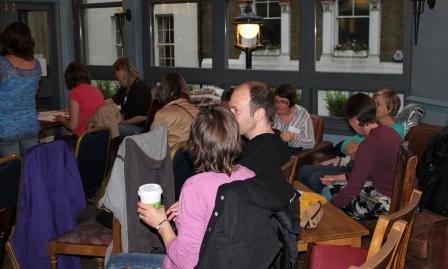
On the evening of Tuesday, 17
th May, the upstairs room at the Theodore Bullfrog pub in Charing Cross was once again the home of the Professional Series, and this time we were treated to the musings of the elegant and witty
Nicolette Jones, children’s books reviewer, journalist and literary scout.
 |
| Candy, Lucy et al before hand |
 |
| Tim and Paolo getting ready |
She started her talk by outlining what she does:
- Contributing a ‘supposedly’ weekly slot in the Sunday Times culture section, paperbacks page (although she sometimes gets nudged out by advertisements!)
- Providing a round-up of children’s books for the Sunday Times at Christmas, Easter and in the summer
- Freelance reviewing and author interviews for the Telegraph and Independent
- Writing on rights for the Bookseller
- Director of the children’s programme of the Oxford Literary festival (for the last two years)
- Scouting for the Louise Allen-Jones agency, looking for English books that might be suitable for overseas publication, particularly Germany (Nicolette actually mentioned this later but I’ve included it here for tidiness!)
She then explained how she got there, reading English Literature at Oxfords and then as a post-grad with a scholarship at Yale, working in the rights department of a London literary agent, then writing for the Readers’ Digest, Publishing News and finally the Sunday Times where she was a general critic (of theatre, cinema, etc) before focussing in, first on fiction in general and then on children’s books.
Her focus on children’s books came when Harry Ritchie, then literary editor, recognised that children’s books should be reviewed by adults using the same objective approach to analysing the writing as they used for adult literature: did the book fulfil the ends it set out to achieve, was the language appropriate, was it funny, etc. Prior to this, children’s books had been languishing in a ghetto where it was assumed that only children’s views of them were of any relevance.
Nicolette finds that she is as stimulated by children’s books as by adults, if in a different way. When choosing books to review (and she has to choose given that nearly 20 parcels of books land on her doormat from publishers each week!) she looks for things that are special and in particular what will turn children into readers. She believes that children will love any book, even a bad one, if it is read to them by a parent, but only a good book will speak directly to a child.
So it isn’t easy to choose, and it can be difficult too to carve out a reviewing slot for such gems. It took three different editorial regimes before Nicolette achieved her weekly slot and even now she sometimes has to bend to editorial considerations which will put reviewing the blockbusters above all else. This isn’t to say she doesn’t have the support of the literary editor. She most certainly does, but there is a lot of competition for space and even Andrew Holgate can’t always pull the shots.
She does however believe that there is more curiosity about children’s books amongst adults than about any other books. After all, a third of publishing income comes from children’s books and that represents one half of all books by volume.
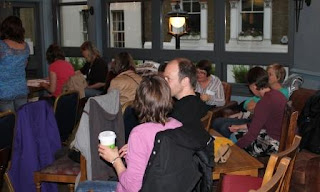 |
| The attendant audience |
After this short introduction, Nicolette offered to take questions:
- On the subject of crossover books, Nicolette believes these help to raise the profile of children’s books no end. The main difficulties are who should review them (children’s or adult’s reviewers) and where should they go in the bookshops. She noted that in Australia bookshops have a 15-25 section and that works really well. She also mentioned that they help dealing with the legacy that you grow out of children’s books. Her own daughter’s teacher said that at 15 you shouldn’t be reading children’s books. Nicolette emailed her list of so-called children’s books that were suitable for 15 year olds! She finds it is often difficult to put age ranges on books.
- Her view of bloggers was generally favourable. She welcomes the conversations that can be had between writers, reviewers and readers by means of the blogs and notes that some of the bloggers are good reviewers, although the whole phenomenon does raise the question of the point of the critic after all bloggers do it for free and so why should someone pay? But, you do need people to tell others about the books. The traditional media have little space for this, bloggers have plenty. Maybe newspaper web-sites might be able to fill the gap, after all, as one of the delegates commented, traditional media reviews tend to carry more weight with the reading and purchasing public.
- Having her own blog was not really an option, however. Nicolette does have web-site and she does participate in things like webcasts, but she doesn’t have time to maintain a blog and she couldn’t review more than she does already.
- She doesn’t believe that publishers are over-publishing. If anything, lists seem to have shrunk. There are definitely fewer picture books but there are some exciting new illustrators coming through recently. She is also encouraged by the new imprints at Macmillan and Random House, Nosy Crow and prizes like the Branford Boase. She would like to see a broader stock in booksellers though. The independents are good and some local branches of the chains do well but more could be done.
- She can’t be bribed to review a book although she has received some ‘amazing’ things as inducements. Flowers and chocolate are always acceptable! She’s not so sure what she was meant to do with the enormous pair of Y-fronts, plastic rat, plastic spiders, and mechanical sperm she has been sent in the past! She tries to look at everything she is sent and she tries to balance the types of books she reviews over a period of time, but whatever she reviews she is looking for a Wow! factor. So she reads a lot of first chapters and if the book hasn’t got going by then, too bad. This has also led her to collect first lines. A favourite is: ‘Her life might have been different if she hadn’t become known as the girl whose grandmother exploded.’
- Self-published books do not tend to attract her and she recommends against it for serious writers as both reviewers and booksellers take far more notice of books that have been published traditionally.
- She is very fond of poetry but says it can be difficult to get poetry reviews included and, except in anthologies, it is difficult to get it published too. She would like to see poetry pamphlets for children.
- She rarely does bad reviews. This is because she chooses books as book of the week. Occasionally she is told to review a blockbuster and if she doesn’t like it she won’t hold back.
- She believes that boys are often very good readers. They just don’t read conventional books. She believes there is a risk of gender stereotyping: boys are non-readers and girls like pink. There are some good books with boy protagonists that could be targeted at boys but get packaged in pink.
- She agrees that books for younger readers do not seem to get many prizes largely because they are too short and wonders if there should be a special prize for shorter fiction series.
- She is happy to review graphic novels, particularly if they use a cinematic technique (although she steers a wide berth around manga).
- Her role as a literary scout is to find books that are particularly suitable for the European market. She often receives manuscripts from publishers as well as books, but she doesn’t look at any unagented, unrepresented manuscripts. For the Germans she is particularly looking for fairy tales for 8-12s but they don’t buy picture books as they prefer their own style in these.
- She is very negative towards book packagers and is saddened by how little parents know about this side of the business. She thinks it’s up to booksellers to explain.
- She would support a children’s book programme on TV providing it was a varied magazine type programme with features (eg inspiration behind a book), controversy, prize news, etc and was aimed at adults.
- Finally on the subject of Sainsbury’s as a bookseller Nicolette took the view that any channel to get books to the public was a good thing and it might actually be less challenging for some potential readers to buy books in a supermarket than in a bookshop.
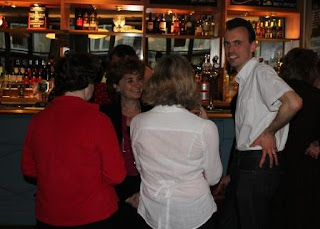 |
| Nicolette smiling as usual and Nick noticing the camera! |
And all that was said in a matter of a busy hour or so, during which this aspiring writer wished she’d studied short-hand and gave thanks that her pen didn’t run out. There were of course lots of further one to one questions before Nicolette left but the individuals concerned will have to reveal the contents of those conversations themselves. It is fair to say, though, that everyone had an informative and entertaining evening and we would all happily welcome Nicolette back to talk again.